Marine Solutions, Inc.
  • Home
  • About Us
    • LEADERSHIP
    • SUSTAINABILITY >
      • COMMUNITY
      • ENVIRONMENT
      • ECONOMY
    • DIVE RIGHT IN
    • INSIGHTS & EXPERTISE
  • Markets
    • FEDERAL
    • ENERGY
    • TRANSPORTATION
    • INDUSTRIAL
    • WATER
    • COMMERCIAL
    • STATE
    • LOCAL
  • Services
    • MARINE ENGINEERING
    • BRIDGE ENGINEERING
    • MARINE CONSTRUCTION
    • COMMERCIAL DIVING
  • Projects
  • Safety
  • Contact Us
  • CAREERS
    • OUR CULTURE
    • INTERNSHIPS
  • Partner With Us

Hydrogen Embrittlement and Stress Corrosion Cracking Risk in High-Strength Steel Tie-Rods at Marine Bulkhead Structures

5/27/2026

0 Comments

 
Anchored steel sheet pile bulkheads represent a significant portion of the aging waterfront infrastructure at U.S. ports and marine terminals. Many of these structures were constructed in the latter half of the 20th century using 150 ksi tie-rods - a material choice that offered cost and weight efficiency at the time but carries long-term risks in aggressive buried marine environments.

The risks are hydrogen embrittlement (HE) and stress corrosion cracking (SCC), and the inability to easily inspect these tie-rods combined with the absence of reliable visual warning indicators prior to fracture makes them particularly challenging to manage. This article addresses the potential failure mechanisms associated with 150 ksi tie-rods, outlines appropriate evaluation and risk mitigation protocols for existing facilities, and provides material selection guidance for new designs.

The Problem with 150 ksi Tie-Rods
The failure mechanisms are hydrogen embrittlement (HE) and stress corrosion cracking (SCC) - two related brittle failure modes that operate silently, without warning deformation, and at stress levels below nominal design capacity.

Hydrogen embrittlement occurs when atomic hydrogen enters the steel matrix through corrosion reactions. Once inside the metal, hydrogen migrates to regions of high triaxial stress - threads, bends, connection points, and surface defects - where it reduces ductility and fracture toughness, enabling brittle crack propagation. The key governing factor is steel strength: published corrosion engineering guidance indicates that steels exceeding approximately 145 ksi are particularly susceptible. At 150 ksi, high-strength steel tie-rods fall squarely into the high-susceptibility range.

Marine buried environments provide the conditions needed to drive this type of failure:
  • Saturated soils, at times with saline or brackish chemistry.
  • Low-oxygen conditions that promote hydrogen-generating cathodic reactions.
  • Corrosion-driven electrochemical breakdown of the rod and its coating.
There is also another factor that is commonly overlooked: the actual stress state of a buried tie-rod is commonly more severe than the design calculations suggest. Fill settlement can induce bending stress at connection points, threads and hardware introduce stress concentrations, and residual stress from fabrication increases the overall stress state.

Why Conventional Inspection Does Not Solve This
The rods are buried and inaccessible, and HE/SCC is localized and time-dependent - it progresses with no external sign until fracture occurs. Once a crack initiates, propagation to fracture is rapid. There is no reliable pre-failure indicator detectable by visual surface inspection.

When the first rod fractures, load redistributes to adjacent rods. If those rods are in a similar state of degradation - which is likely given shared age, environment, and material - progressive fracture can follow. In severe cases, the result is total loss of the bulkhead structure.

Increasing the factor of safety or adding redundancy does not eliminate the risk, because the mechanism is governed by material susceptibility and environment - not simply by nominal stress levels.

Recommendations
New Designs
Avoid specifying 150 ksi tie-rods for buried deadman applications in marine environments. Instead:
  • Select steels in the 75-100 ksi yield range with documented marine service history.
  • Use articulated connections to reduce bending stress at threaded connections.
  • Treat coatings as a supplemental measure, not a primary defense.
Existing Facilities
The following six-step protocol is appropriate for existing facilities:
  1. Identify and prioritize. Review as-built records and prior inspection reports. Flag all marine bulkhead structures constructed using 150 ksi tie-rods. Prioritize based on age, environment, surcharge loading, and evidence of prior wall movement or distress.
  2. Excavate and inspect. Expose representative tie-rods at the wall connection, mid-span, and deadman. Assess coating condition, corrosion state, connection hardware, and surrounding soil chemistry.
  3. Sample and test. Where corrosion or coating breakdown is found, obtain samples for hardness testing, metallurgical examination, slow strain rate or hydrogen susceptibility testing, and fracture toughness testing if warranted. Soil and groundwater samples should be tested for pH, chloride concentration, sulfate content, resistivity, and dissolved oxygen to characterize the aggressiveness of the buried environment.
  4. Assess remaining capacity. Where inspection and testing indicate HE/SCC susceptibility or material degradation, remaining system capacity should be evaluated, including load redistribution scenarios if one or more tie-rods are compromised. Environmental data from soil and groundwater testing should be incorporated into the assessment to characterize the ongoing severity of exposure and inform assumptions about the rate and extent of degradation across the tie-rod system. Findings and their structural implications should be formally documented. Continued operation under these conditions represents a risk-informed decision - not a finding of adequate condition - and a defined path forward is required, whether through a risk management plan or remediation.
  5. Implement a risk management plan (if remediation is deferred). If remediation is deferred, a formal risk management plan should be put in place. This plan should include defined operational load restrictions, such as reduced surcharge limits or restricted vessel mooring and berthing loads; active deflection and movement monitoring with clearly defined threshold values that trigger escalated response; and a defined re-evaluation interval - not an open-ended monitoring program. It is important to understand what monitoring can and cannot detect. Because HE and SCC fracture provides no reliable visual warning and tie-rod systems have limited redundancy, wall deflection monitoring can detect system-level response to progressive failure but cannot reliably detect individual tie-rod failure before it occurs. Once a single tie-rod fractures, load redistribution to adjacent tie-rods can accelerate progressive failure faster than monitoring can provide actionable warning. A risk management plan extends the decision-making window, but it does not eliminate the underlying risk - it manages it until remediation can be executed.
  6. Remediate. When remediation is elected, or when monitoring thresholds are exceeded, several options are available - each addressing the risk to a different degree. Limiting surcharge loads and restricting mooring and berthing operations reduces demand on the tie-rods but does not address the underlying degradation mechanism. Installing additional grouted tieback anchors or a pile-supported relieving platform reduces the loading in the existing tie-rods and can meaningfully lower the risk of progressive failure, but the original 150 ksi tie-rods remain in place and continue to be subject to HE and SCC in the buried environment. Excavating and replacing the 150 ksi tie-rods with lower-strength steel in the 75-100 ksi range is the only option that fully eliminates the HE/SCC risk mechanism. The appropriate choice depends on the severity of confirmed degradation, facility operational requirements, and owner risk tolerance - with a clear distinction between options that manage the risk and the one option that eliminates it.

Conclusion
High-strength tie-rods were installed widely across U.S. waterfront infrastructure in the latter half of the 20th century, and many remain in service today. HE and SCC are credible failure modes for high-strength steels in aggressive buried environments, and both progress without observable warning prior to fracture. The costs of proactive investigation and remediation are significant but are substantially lower than the consequences of undetected failure.
​
For new designs, specify tie-rod steel in the 75-100 ksi yield range. For existing facilities where the tie-rod material grade is unknown, verify the grade against available as-built records. Where 150 ksi tie-rods are confirmed or suspected, follow the protocol described above to assess the condition and determine the appropriate risk mitigation measures.

​Author: Bradley A. Syler, PE, SE
0 Comments

Navigating Encased Pile Unknowns for Structural Assessment and Load Rating

5/15/2026

0 Comments

 
In-water structural piles are commonly repaired and preserved via structural encasements. A deteriorated zone on a steel, timber, or concrete pile gets encased with cast-in-place reinforced concrete or a grouted FRP jacket and the structure returns to service. When properly designed and installed, these systems restore section capacity and extend service life. That part of the story is reasonably well understood.

What gets less attention is what happens afterward - specifically, when a structural assessment or load rating analysis is required years or decades later. At that point, the condition of the original pile beneath the encasement is no longer directly observable. What it looked like before the encasement was installed and whether deterioration has continued since installation are questions that cannot be answered from a visual inspection of the encasement exterior.

That uncertainty has real consequences for structural assessment and load rating work. Addressing it requires a structured approach - starting with whatever documentation exists and proceeding to field investigation where the documentation is absent or insufficient.

Why Encasements Complicate Things
The structural capacity of an encased pile is a function of both the original pile and the encasement acting together. Determining that combined capacity requires knowing the condition of the original pile at the time the encasement was installed and what the encasement was designed to do - specifically, whether it was intended to supplement or fully replace the pile's capacity in the deteriorated zone.

These questions are not answerable from a post-repair inspection of the encasement exterior. The result is a data gap that, if not explicitly addressed, can lead to one of two problems: an unconservative assessment where the pile's actual capacity is less than assumed; or unnecessary conservatism that understates the pile's true load-carrying capacity.

There is also another question that is easy to overlook: encasement systems do not inherently stop deterioration of the original pile. Whether they do depends on the type of system, the quality of the seals at the top and bottom of the encasement, and if the encasement material has remained impermeable. Some systems slow deterioration without fully arresting it. Whenever possible, structural assessments or load ratings should be based on measured conditions, not on an assumption that the encasement has provided complete isolation.

Start with the Documents
The process should begin with a thorough review of what is on record before any investigations are planned. Four document types are relevant, and they should be reviewed in sequence because each one informs how to interpret the next.

Original Design Documents
These establish the baseline: pile geometry, material grades, section properties, and original design loads. All subsequent capacity reductions due to deterioration are measured against this baseline. Where original design documents are unavailable, field measurements and material testing may be required before the assessment can proceed.

Pre-Repair Inspection Reports
These are typically the most valuable documents in the entire assessment. They represent the only direct, systematic observation of the original pile before it was permanently concealed. Useful data includes quantitative section loss measurements, photographic documentation, the vertical extent and location of deterioration, and the inspector's description of the deterioration mechanism. Where pre-repair records exist, they can be used to estimate residual section properties at the time of repair - the most defensible basis for the current assessment. Their absence is a significant gap that must be explicitly acknowledged and addressed, not papered over with an assumed condition.

Repair Design Documents
These describe what the encasement was designed to do and what condition of the original pile was assumed by the repair design engineer. The key comparison is between the assumed pre-repair condition used in the repair design and the measured condition documented in the pre-repair inspection reports. Where the repair design assumed less deterioration than was actually measured, the pile's actual condition going into the repair was worse than the repair was designed for - which has direct implications for current residual capacity.

Post-Repair Inspection Reports
These document the observable condition of the encasement at various points after installation. Cracking or spalling in concrete encasements, delamination in FRP jackets, and rust staining or leakage at the encasement seals can all indicate internal distress. The important limitation: a clean-looking encasement exterior does not confirm the original pile beneath is undamaged or that deterioration has been arrested.

When Field Investigation Is Needed
Where the documentation record is incomplete, contains gaps that cannot be resolved from the record alone, or where the structural assessment or load rating analysis is sensitive to section loss assumptions, targeted field investigation is the appropriate path forward. The primary techniques applicable to encased piles are:
  1. Coring through the encasement and original pile. The most direct method. A rotary drill core extracted through the encasement, interface zone, and original pile provides physical samples and direct condition information for each layer. Cores can be submitted for laboratory testing including compressive strength, chloride ion content, carbonation depth, and petrographic analysis. Core diameters typically range from 2 to 4 inches depending on aggregate size and testing requirements. Core locations should prioritize zones of known or expected maximum deterioration: the splash and tidal zones, the mudline zone, and any locations where prior inspections noted distress. Core holes must be patched upon completion.
  2. Ground-penetrating radar (GPR). Can identify voids, delamination, and reinforcing steel in concrete encasements and FRP jackets. Applicable above water and, in some cases, below water with direct contact on the encasement surface. Below water use is limited to freshwater as saltwater's high electrical conductivity causes too much signal attenuation. Applicability should be evaluated on a case-by-case basis given physical and technical limitations.
  3. Ultrasonic thickness testing (UT). For steel piles within concrete encasements and FRP jackets, measures remaining pile thickness after access to the steel surface is established through a cored or drilled access port. Most effectively used in combination with partial-depth coring: the core provides data on the encasement condition and access to the steel pile surface, and the UT provides quantitative data on remaining pile thickness. Core or drill holes must be patched upon completion.
  4. Corrosion potential testing. For steel piles within concrete encasements and FRP jackets, corrosion potential measurements can indicate the probability of active corrosion at the embedded steel surface. A conductive path to the embedded steel is required, typically through a cored or drilled access port. Results should be interpreted cautiously as the access penetration alters local electrochemical conditions by changing oxygen availability and moisture at the steel surface. Measurements therefore reflect conditions at the point of penetration, which may differ from conditions across the broader under encasement interface.
  5. Timber resistance drilling. For timber piles within concrete encasements or FRP jackets, timber resistance drilling can indicate the presence of internal timber pile decay, voids, or section loss after access to the timber surface is established through a cored or drilled access port. The access port must be large enough to allow the resistance drill to reach the timber surface. Most effectively used in combination with partial-depth coring: the core provides data on the encasement condition and access to the timber pile surface, and the resistance drill provides data on the internal condition of the timber pile. Core or drill holes must be patched upon completion.
  6. Partial or complete removal of encasement. The most comprehensive method for direct evaluation of the original pile condition beneath an encasement. Removal exposes the original pile surface for direct visual inspection, measurement of section loss, and other surface-level assessments without the constraints of access ports or indirect methods. Partial removal - such as chipping out a defined area of a concrete encasement - can be effective where deterioration is expected to be localized, limiting cost and restoration scope. Full removal provides complete access but is the most costly option and requires full encasement replacement upon completion. Best suited for situations where other methods have produced inconclusive results and the findings will directly inform a sensitive repair or load rating decision.

Addressing Remaining Uncertainty
Where data gaps remain after documentation review and field investigation, the remaining uncertainty needs to be explicitly stated in the structural assessment or load rating analysis - not silently absorbed into an assumed condition. Appropriate treatments include:
  • Bounding analyses that bracket the plausible range of section loss.
  • Conservative section loss assumptions traceable to similar structures or environments.
  • Applied capacity reduction factors where pile condition is poorly documented.
Where field investigation indicates that deterioration has continued since the encasement was installed, the structural assessment or load rating analysis should account for the time-dependent reduction in capacity. A comparison of pre-repair deterioration to current measured deterioration, divided by elapsed time, gives an average deterioration rate that can be used to estimate when the pile is no longer adequate to support the required loading.

​Final Thought
Encasement repairs are a standard and effective tool for repairing and extending the service life of in-water structural piles. The challenge they create for subsequent structural assessment or load rating analysis is real but manageable - provided the work is approached with structured documentation review, targeted field investigation, and explicit treatment of remaining uncertainty.

​Author: Bradley A. Syler, PE, SE
0 Comments

What’s Poppin’ with ESOP: A Celebration of Ownership

5/4/2026

0 Comments

 
Our What’s Poppin’ with ESOP event brought teams together across all offices and even in the field to celebrate what it means to be employee-owners.

Team members enjoyed a build-your-own popcorn bar with a variety of toppings, explored ESOP facts displayed throughout each location, and connected with ESOP Committee members who were available to answer questions and share insights.

Most importantly, the event highlighted the power of ownership that unites us all, no matter where we work. It was a fun and meaningful way to celebrate the role each of us plays in our shared success.
0 Comments

Design-Build Delivery for Marine Infrastructure: Reducing Risk and Improving Outcomes for Complex Waterfront Projects

5/4/2026

0 Comments

 
Marine infrastructure - including navigation structures, bulkheads, wharves, piers, and guide walls - is essential to economic activity and national logistics networks. Many of these assets are aging and require rehabilitation or replacement under increasingly constrained budgets and demanding operational conditions.

Marine construction projects are commonly performed in environments with limited accessibility and continuous exposure to hydraulic, environmental, and operational forces. Construction activities must frequently occur within restricted environmental windows, active navigation corridors, and around structures that remain in service throughout the work. These realities demand a project delivery approach that is inherently adaptive, collaborative, and risk-aware.

Traditional Design-Bid-Build (DBB) delivery methods require completion of design prior to contractor involvement, creating a fundamental disconnect between design assumptions and construction realities. In contrast, Design-Build (DB) delivery integrates these functions under a single entity, enabling more responsive and efficient project execution.

This article examines the application of design-build delivery in marine construction, focusing on its ability to reduce risk, improve constructability, and deliver better outcomes for infrastructure owners navigating complex waterfront projects.

​Background and Industry Context
Characteristics of Marine Construction

Marine construction projects present several defining characteristics that distinguish them from land-based work:
  • Limited access: Work is performed from barges, temporary platforms, or underwater, reducing efficiency and increasing complexity. Equipment mobilization and material handling require specialized marine plant and careful logistical planning.
  • Environmental constraints: Tides, river stages, currents, wave action, and weather significantly influence construction operations and can halt work for extended periods.
  • Operational constraints: Many projects occur adjacent to active navigation channels or operational port and terminal facilities, requiring careful coordination to avoid disruptions to commerce and vessel traffic.
  • Inspection limitations: Underwater visibility and access restrict the accuracy of pre-design condition assessments. Submerged elements are often difficult to evaluate comprehensively, even with underwater inspection and underwater acoustic imaging.
These factors contribute to a high likelihood of encountering unforeseen conditions during construction which can fundamentally alter the scope, cost, and schedule of a project if the delivery method lacks the flexibility to respond.

Limitations of Design-Bid-Build Delivery
The Design-Bid-Build model separates design and construction into sequential, contractually distinct phases. While widely used and well understood, this approach introduces several limitations that are amplified in the marine environment:
  • Limited incorporation of contractor expertise during design: The contractor is not engaged until after design is complete, meaning practical construction knowledge - particularly regarding means and methods - is absent from critical design decisions.
  • Fragmented risk allocation: Responsibility is divided between the designer and the contractor, often leading to ambiguity when unforeseen conditions arise. The owner frequently bears the burden of resolving disputes between the two parties.
  • Increased potential for change orders and claims: When underwater conditions differ from design assumptions - a common occurrence in marine work - the result is often redesign, procurement delays, and contract modifications that drive up costs and extend schedules.
  • Coordination burden on the owner: The owner must manage multiple contracts, schedules, submittals, and lines of communication across separate firms, adding administrative complexity and risk.
In marine construction, where unknowns below the waterline are the rule rather than the exception, these limitations can transform manageable projects into contentious, over-budget endeavors.

The Design-Build Delivery Framework
Design-build delivery consolidates design and construction responsibilities within a single entity, fundamentally changing the dynamics of project execution. This integration allows for:
  • Early integration of construction methods into design: The builder's knowledge of means, methods, and equipment informs the design from the outset, producing documents that are inherently more constructable.
  • Continuous feedback between field conditions and engineering decisions: As conditions are revealed during construction - particularly underwater - the design team can adapt in real time without the delays of formal change order processes between separate organizations.
  • Overlapping design and construction activities: Design-build enables fast-tracking, where construction on well-defined elements can proceed while design continues on others, compressing the overall project timeline.
  • Unified responsibility for risk management: A single entity owns the outcome from investigation through project closeout, eliminating finger-pointing and creating a natural incentive to identify and mitigate risks proactively.
This integrated approach is particularly well suited to marine construction, where adaptability, constructability, and rapid decision-making are not luxuries - they are necessities.

Advantages of Design-Build for Infrastructure Owners
Risk Allocation and Management
One of the most significant advantages of design-build is its ability to align risk with the party best equipped to manage it. In marine construction, key risks include:
  • Underwater uncertainty: Submerged conditions are inherently difficult to characterize fully before construction begins. Design-build allows the team to adapt designs as actual conditions are revealed, rather than forcing the owner to negotiate change orders between separate firms.
  • Constructability challenges: Marine work involves specialized equipment, environmental work windows, and complex sequencing. When the entity responsible for design is also responsible for construction, designs naturally account for these realities.
  • Means and methods selection: The design-build team can select and optimize construction approaches based on integrated engineering and field knowledge, rather than having a contractor attempt to execute a design developed without their input.

By consolidating responsibility, design-build reduces the potential for disputes and encourages proactive risk mitigation. The owner benefits from a single point of accountability - one contract, one schedule, and one team responsible for delivering the project.

Constructability and Innovation
Early contractor involvement is a hallmark of design-build, and it produces designs that reflect actual construction conditions rather than theoretical assumptions. This integration fosters innovation that is difficult to achieve under traditional delivery:
  • Modular and precast solutions: Design-build teams frequently leverage prefabricated elements - such as precast concrete blocks or modular structural components - that can be manufactured offsite and assembled in the water. This approach reduces reliance on difficult and time-consuming in-water construction, simplifies installation, and improves quality control.
  • Optimized construction sequencing: The integrated team can design the project around the most efficient construction sequence, accounting for environmental windows, equipment capabilities, and site access constraints from the start.
  • Improved durability and maintainability: When the builder participates in design, practical considerations like long-term maintenance access, material durability in the marine environment, and resilience against future impacts (such as vessel strikes) are incorporated from the beginning.
These types of innovative, practical solutions are far less likely to emerge under traditional delivery methods, where the designer and contractor operate in isolation.

Schedule and Cost Benefits
Design-build facilitates meaningful schedule compression and cost control through several mechanisms:

Schedule advantages:
  • Parallel execution of design and construction activities, rather than sequential phasing
  • Early procurement of long-lead materials and specialized equipment
  • Reduced delays associated with redesign when field conditions differ from assumptions
  • Elimination of the re-mobilization gaps that occur when transitioning between separate design and construction contracts

Cost advantages:
  • Fewer change orders, as constructability issues are resolved during design rather than discovered during construction
  • Improved construction efficiency through designs optimized for the builder's equipment and methods
  • Reduced overall project duration, which lowers time-dependent costs such as equipment rental, marine plant, and environmental monitoring
  • Real-time constructability input during design allows pricing to be validated before documents are finalized, reducing the contingencies that contractors build into bids under traditional delivery

Industry experience consistently demonstrates that in-water construction can take two or more times longer than equivalent out-of-water work. Design-build teams, by integrating this knowledge into the design process, can maximize offsite fabrication and minimize the duration of the most difficult and expensive construction activities.

Operational Continuity
For infrastructure owners, minimizing disruption to ongoing operations is often as important as the construction itself. Navigation channels must remain open, terminals must continue to function, and adjacent facilities must be protected. Design-build supports operational continuity through:
  • Phased construction approaches: The integrated team can design and sequence the work to maintain operations throughout construction, completing the project in stages that minimize closures and restrictions.
  • Reduced interference with navigation or terminal operations: By optimizing construction methods and schedules around operational demands, design-build minimizes the impact on vessel traffic and commercial activity.
  • Greater flexibility in responding to operational constraints: When unexpected operational needs arise - such as emergency vessel movements or seasonal traffic surges - the design-build team can adapt the construction schedule and approach without the contractual friction inherent in multi-party delivery.

Simplified Owner Experience
Beyond the technical and financial advantages, design-build fundamentally simplifies the owner's role in project delivery:
  • Single point of contact: The owner manages one relationship, one contract, and one schedule, rather than coordinating between multiple firms with potentially competing interests.
  • Reduced administrative burden: Submittals, RFIs, schedule updates, and progress reporting flow through a single entity, streamlining communication and decision-making.
  • Faster issue resolution: When problems arise the design-build team resolves them internally rather than generating claims and disputes that the owner must adjudicate.

Conclusion
Marine construction projects are inherently uncertain and complex, requiring delivery methods that can adapt to changing conditions in real time. Traditional design-bid-build approaches, while familiar and widely used, are often poorly suited to these environments due to their inherent fragmentation, rigid sequencing, and limited flexibility.
Design-build delivery provides a more effective framework by integrating investigation, design, and construction into a single, cohesive process. This integration enables:
  • Improved risk management through unified responsibility and proactive mitigation
  • Enhanced constructability through early and continuous builder involvement in design
  • Accelerated project delivery through parallel activities and reduced rework
  • Reduced cost growth through fewer change orders and optimized construction methods
  • Greater operational continuity through flexible, phased construction approaches
For complex marine infrastructure projects design-build should be considered the preferred delivery method. Its integrated approach directly addresses the unique challenges of the marine environment and delivers measurably better outcomes for infrastructure owners.

Recommendations for Infrastructure Owners
To maximize the benefits of design-build in marine construction, infrastructure owners should consider the following best practices:
  1. Develop clear, performance-based project requirements. Define the desired outcomes and performance criteria rather than prescribing specific designs or methods. This gives the design-build team the flexibility to innovate and optimize.
  2. Prioritize qualifications and technical expertise in procurement. Select design-build teams based on demonstrated experience in marine construction, engineering capability, and a proven track record of integrated delivery - not solely on low price.
  3. Allow flexibility for innovation and alternative technical approaches. Encourage proposers to offer creative solutions that leverage their combined design and construction expertise. The best outcomes emerge when teams are empowered to solve problems, not just follow prescriptive specifications.
  4. Encourage early and thorough field investigation. Invest in comprehensive pre-design data collection - including structural inspections above and below water, geotechnical sampling, bathymetric surveys, and material testing. The more that is known before design begins, the fewer surprises will arise during construction.
  5. Align contract structures to support adaptive decision-making. Marine projects will encounter unforeseen conditions. Contract terms should facilitate rapid, collaborative responses rather than adversarial change order negotiations. Structures that allow for adaptive decision-making - such as allowances for differing site conditions and mechanisms for real-time scope adjustments - produce better project outcomes for all parties.

Design-build delivery represents a fundamental shift in how marine infrastructure projects are planned, designed, and constructed. Unifying these traditionally separate functions creates a delivery framework that is better aligned with the realities of working on and under the water where adaptability, collaboration, and integrated expertise are the keys to success.

​
Author: Bradley A. Syler, PE, SE
0 Comments

Building Stronger Communities, One Tree at a Time

4/20/2026

0 Comments

 
Picture
There’s something powerful about getting your hands in the dirt and knowing it makes a difference.

On Saturday, April 18, a group from Marine Solutions, including Sean Chapman, PE, John Fangmeyer, EIT, Ashley Sanders, and Megan Kauffman, joined hundreds of volunteers at the 27th Annual Reforest the Bluegrass event. The initiative focuses on expanding tree canopy in local parks, strengthening ecosystems for wildlife, and improving air and water quality across the region.

What stood out most to our team was not just the act of planting trees, but seeing the results of past efforts. Nearby, taller trees from earlier Reforest the Bluegrass events served as a reminder that these efforts create lasting impact. It reinforced our belief that the work we do today contributes to a healthier environment for the future.

Participating in Reforest the Bluegrass reflects our commitment to supporting environmental initiatives that strengthen the communities where we live and work. Opportunities like this allow our team to contribute in a meaningful, hands-on way while supporting long-term environmental stewardship.
​
We are proud of our team for contributing their time and effort to a cause that will continue to grow and benefit the community for years to come.

0 Comments

Enhancing Resilience and Performance for River Bend Ag's New Madrid Dock Facility

4/1/2026

0 Comments

 
Building on a strong history of successful project delivery for River Bend Ag, LLC, Marine Solutions was selected to provide design-build services for upgrades at their New Madrid dock facility. This work supported the recent replacement of the facility’s material handling equipment. 

Marine Solutions led the design and construction for the installation of two new 72-inch monopile dolphins and associated pile guide systems connected to the existing dock barge. Dive teams also performed demolition of existing structures and identified debris and hazards to support safe pile driving operations.

These improvements enhanced the captured barge dock’s resilience and increased operational capabilities during extreme high-water conditions.

Working collaboratively with the owner and a trusted subcontractor, Marine Solutions delivered a turn-key seamless solution within six months of proposal, strengthening River Bend Ag’s operations and improving efficiency for the local agricultural community.
Picture
Picture
Picture
0 Comments

Marine Solutions, Inc. Named One of the Best Places to Work in Kentucky 2026

3/11/2026

0 Comments

 
Picture
22nd Annual Best Places to Work in Kentucky Award Winners Announced

FRANKFORT, Ky.  – The Kentucky Chamber of Commerce, the Kentucky Society for Human Resource Management (SHRM Kentucky) and Saint Joseph Health announce the 100 companies (in alphabetical order) that made the 22nd Annual Best Places to Work in Kentucky list.

The winner rankings will be announced at the awards dinner Thursday, June 18, 2026, at the Central Bank Center in Lexington.

Winners from across the state have been selected in three categories: small companies of 15-149 employees, medium companies of 150-499 employees and large companies consisting of more than 500 employees (categories based on number of U.S. employees, only Kentucky employees surveyed). The selection process, managed by Workforce Research Group, is based on an assessment of the company’s employee policies and procedures and the results of an internal employee survey.

The competition is a multi-year initiative designed to motivate companies in the Commonwealth to focus, measure and move their workplace environments toward excellence. Numerous studies show a strong correlation between profitability and creating a good place to work.

For over 75 years, the Kentucky Chamber of Commerce has represented the interests of member businesses throughout Kentucky – from family-owned shops to Fortune 500 companies. As the state’s premier business advocate, the Kentucky Chamber is a recognized and respected voice across the Commonwealth, working every day to unite business and advance Kentucky.

SHRM Kentucky consists of 12 local chapters that provide ongoing education and leadership opportunities for over 3,000 human resource professionals throughout the Commonwealth.

For more details about Best Places to Work in Kentucky, visit bestplacestoworkkentucky.com. 
0 Comments

Steel Tank Evaluation using FEA

11/4/2025

0 Comments

 
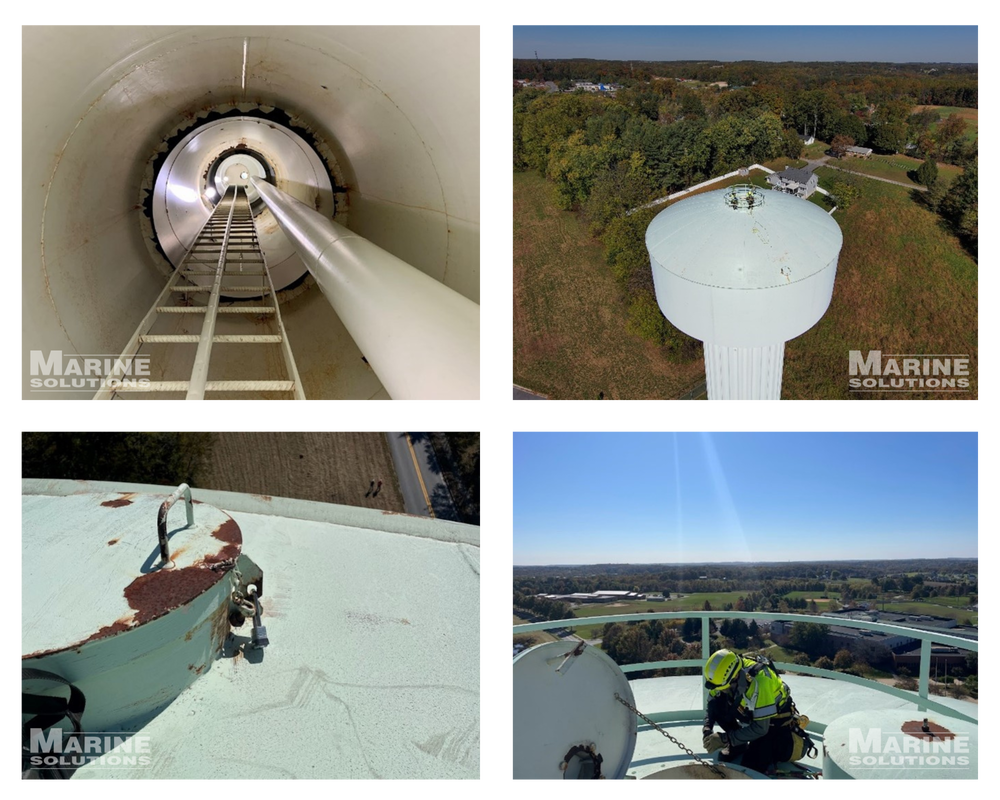
Marine Solutions recently evaluated a 42-foot diameter, 33-foot tall steel storage tank.  Our team was tasked with developing a 3D finite element model to determine how the tank would perform under high wind conditions after two new 3’x7’ wall openings were cut into the tank wall.

Because of the tank’s size and geometry, finite element analysis (FEA) was the ideal method for accurately predicting stress levels throughout the tank wall. The tank’s wall thickness varied from 3/16" at the base to 3/32" at the top, making it especially vulnerable to buckling under compression. Cutting new openings in the tank wall further increased compressive stresses in the surrounding areas.

Our analysis revealed that reinforcing steel angles would be required around the new openings to maintain the tank’s structural stability.

A standout feature of this project was the quick turnaround time. Our team developed the 3D model, performed the analysis, and delivered results to the client in less than one week, keeping the project moving without disruption to the project schedule.

We’re grateful to our client for the opportunity to support them on this unique and fast-paced project.

Learn more about our engineering and analysis services: MSImarinesolutions.com/services.
Picture
External View of Tank to Be Analyzed
Picture
Internal View of Tank to Be Analyzed
Picture
Finite Element Analysis (FEA) Model of Tank with Opening
0 Comments

Reinforcing the Riverfront: Upgrades to a Pennsylvania Marine Terminal

10/29/2025

0 Comments

 
In April 2024, Marine Solutions conducted a routine inspection of the waterfront structures at a marine terminal in Pennsylvania. The inspection included an assessment of the above- and below-water conditions of the structural components, collection of river bottom soundings and underwater soil samples, and prioritized repair recommendations. A mooring analysis was also performed to establish mooring limits for vessels typically occupying the berth.

The terminal is located on the Monongahela River and consisted of steel sheet pile mooring cells, tri-tie dolphins, and a platform structure. With a nearby lock and dam scheduled to be demolished—lowering the normal pool elevation by approximately 3.2 feet—the client required dredging in the berth area to maintain adequate vessel clearance and accommodate changing navigation conditions. Our team provided periodic hydrographic surveying and dredging support.

By October 2025, our team had completed a comprehensive repair project at the terminal, from design through construction. Work included installing new cell bands, demolishing and replacing an existing cell with a tri-tie pipe pile dolphin, removing and replacing concrete and steel bump-outs with driven pipe piles, upgrading mooring fittings, reinstalling two stairways, and providing additional dredging operations.
​
These efforts strengthened the terminal’s infrastructure and supported continued safe and efficient unloading operations for asphalt transport barges.
Picture
Picture
Picture
0 Comments

Marine Solutions, Inc. Celebrates First ESOP Statement Day

8/14/2025

0 Comments

 
This week, we celebrated our very first ESOP Statement Day! Once a year, we’ll take time to open our ESOP statements, see how our ownership shares have grown, and celebrate the fact that we’re all in this together as employee-owners.

We kicked things off with “Scoops of Ownership,” an ice cream social that made the day even sweeter. Whether you were in the office or out in the field, we made sure everyone had a chance to join in the fun and share in the excitement.

ESOP Statement Day isn’t just about a number on a page. It’s a reminder that everything we do, every project, every problem solved, every client served, adds to something we all own and are building together.
​
Here’s to growing our future as a team. Happy first ESOP Statement Day!
0 Comments

2025 Intern Spotlight

7/29/2025

0 Comments

 
0 Comments

Marine Solutions at Ports '25

6/6/2025

0 Comments

 
We’re back from the Ports '25 Conference and still energized by the exchange of ideas, meaningful conversations, and shared passion for the future of our nation’s infrastructure.

Hosted by the American Society of Civil Engineers (ASCE), the PORTS Conference is a leading technical forum bringing together professionals from across the maritime, port, and coastal infrastructure sectors. It's an invaluable opportunity for us to discuss the latest research, innovations, and challenges shaping our waterways and working waterfronts.

Marine Solutions had the honor to present on numerous topics this year, ranging from advances in marine engineering technology to practical real world applications. We’re proud of the expertise our team shared and the thoughtful discussions they helped lead.

Ports has always been and continues to be a highlight for our team, not only for its professional development value but also for the chance to connect with peers, build relationships, and engage with the broader marine infrastructure community.
​
Scroll down to see some highlights from this year’s conference.
0 Comments

EMPLOYEE SPOTLIGHT: Chloe Touze

4/2/2025

0 Comments

 
Picture
,Q: How long have you worked at Marine Solutions?
"Just under a year, but I’m getting close!"

Q: What is your role and what does your job entail?
"I’m a project engineer-diver which means that I spend a lot of time inspecting structures above and below water. This allows us to gather valuable information on the condition of a clients asset in order to determine what sort of repairs or maintenance might be necessary."

Q: What do you like most about your job AND why?
"One of my favorite things about my job is the continuous need for skills development and learning. Whether it be learning new access methods like diving and climbing, keeping up with new technologies in non-destructive testing, or learning to manage projects, the job keeps me on my toes. I also really appreciate the amount of time that I get to spend outside and traveling to new places."

Q: What three words best describe you?
"Adaptable, curious, dependable"

Q: What do you like to do in your spare time?
"I really enjoy being outside with my friends and my partner. We spend tons of time hiking, biking, and skiing when we have good snow. When I’m back home in Florida I also spend time cave and tech diving. After long days outside, really enjoy cooking my way through cookbooks and sharing meals with my friends."
​
Q: If given the chance, who would you like to trade places with for a day AND why?
"Robert Irwin. Since I was little, I’ve been a big fan of the Irwin family. I’d love to spend the day wandering around the Australia Zoo meeting all the animals and maybe even feeding a croc or two."

Q: If you were to write a book about yourself, what would you name it?
"Diving Into My Life"

Q: What advice do you have for prospective Marine Solutions candidates?
"Don’t be afraid to ask questions or push to learn new skills. We can get very busy, but Marine Solutions is always willing to help you reach your career goals."
Picture
Picture
Picture
0 Comments

Marine Solutions, Inc. Named One of the Best Places to Work in Kentucky 2025

3/7/2025

0 Comments

 
Picture
21st Annual Best Places to Work in Kentucky Award Winners Announced

FRANKFORT, Ky. – The Kentucky Chamber of Commerce, the Kentucky Society for Human Resource Management (KYSHRM) and CHI Saint Joseph Health announce the 100 companies (in alphabetical order) that made the 21st Annual Best Places to Work in Kentucky list.

The winner rankings will be announced at the awards dinner Thursday, May 22, 2025, at the Central Bank Center in Lexington.

Winners from across the state have been selected in three categories: small companies of 15-149 employees, medium companies of 150-499 employees and large companies consisting of more than 500 employees (categories based on number of U.S. employees, only Kentucky employees surveyed). The selection process, managed by Workforce Research Group, is based on an assessment of the company’s employee policies and procedures and the results of an internal employee survey.

The competition is a multi-year initiative designed to motivate companies in the Commonwealth to focus, measure and move their workplace environments toward excellence. Numerous studies show a strong correlation between profitability and creating a good place to work.

For over 75 years, the Kentucky Chamber of Commerce has represented the interests of member businesses throughout Kentucky – from family-owned shops to Fortune 500 companies. As the state’s premier business advocate, the Kentucky Chamber is a recognized and respected voice across the Commonwealth, working every day to unite business and advance Kentucky.

Kentucky SHRM consists of 12 local chapters that provide ongoing education and leadership opportunities for over 3,000 human resource professionals throughout the Commonwealth.

For more details about Best Places to Work in Kentucky, visit bestplacestoworkkentucky.com​.

0 Comments

EMPLOYEE SPOTLIGHT: Brian Giltner, PhD, SE, PE

2/18/2025

0 Comments

 
Picture
Q. How long have you worked at Marine Solutions? 
"
A little over a year."
 
Q. What is your role, and what does your job entail? 
"
As a senior engineer, I have years of experience working on design and construction projects. That is demonstrated by the grey and white hair. As a senior engineer, I create training programs for junior engineers to broaden their understanding of design engineering, guiding them through standards and codes. In addition, I create the procedures, guidelines, and design engineering work methods. This aids in our company-wide consistency. Working with other engineers on the special projects that Marine Solutions is able to support is one of the most enjoyable aspects of my profession. Since joining the organization, I have worked on projects from New York City to the gulf coast of Texas and all the way west to Utah." 
​  
Q. What do you like most about your job AND why? 
"
Being able to teach, mentor and share all the knowledge I have gained over the years. " 
 
Q. What three words best describe you? 
"
Focused, Loyal, Driven"
 
Q. What do you like to do in your spare time?
"
My three favorite hobbies are martial arts, woodworking, and cooking. I have been building furniture since I was a child.  My dad was my first woodworking teacher.  I had to learn how to build with hand tools before I was allowed to use power tools."
 
Q. If given the chance, who would you like to trade places with for a day AND why? 
"
Dan Inosanto – one of the greatest martial artists of all time.  He was Bruce Lee’s best friend and was one of Bruce’s teachers.  Little known fact: Dan taught Bruce how to use nunchucks for the movie Enter the Dragon."
​ 
Q. If you were to write a book about yourself, what would you name it? 
"
Never Stop Learning" 
 
Q. What advice do you have for prospective Marine Solutions candidates? 
​"
Marine Solutions is company that sees you as a person, respects you for your talents, and supports  you as you grow.​"
Picture
Picture
Picture
Picture
0 Comments
<<Previous
OUR LOCATIONS
Picture
Picture
Picture
OUR MARKETS
Federal
Energy
Transportation
Industrial
Water
Commercial
State
​Local
​OUR SERVICES
Marine Engineering
Bridge Engineering
Marine Construction
Commercial Diving
OUR COMPANY
About us
Contact us
Careers
Sustainability
File Upload
News and Insights
© 2010-2026 Marine Solutions, Inc.
​AFFILIATES
Picture
Protections for Reporting Fraud in New York
  • Home
  • About Us
    • LEADERSHIP
    • SUSTAINABILITY >
      • COMMUNITY
      • ENVIRONMENT
      • ECONOMY
    • DIVE RIGHT IN
    • INSIGHTS & EXPERTISE
  • Markets
    • FEDERAL
    • ENERGY
    • TRANSPORTATION
    • INDUSTRIAL
    • WATER
    • COMMERCIAL
    • STATE
    • LOCAL
  • Services
    • MARINE ENGINEERING
    • BRIDGE ENGINEERING
    • MARINE CONSTRUCTION
    • COMMERCIAL DIVING
  • Projects
  • Safety
  • Contact Us
  • CAREERS
    • OUR CULTURE
    • INTERNSHIPS
  • Partner With Us